
Table of Contents
- Abstract
- Introduction
- Peer Reviews & Acknowledgements
- Methodology
- Pre-Test and Client Sorting
- Environment Cleaning & Benchmarking
- Control & Test Periods
- Schema Placed
- Considerations
- Search Engines and LLMs Tested
- Queries & Metrics Tracked
- Analyzing the Results
- Potential Criticisms
- SERP Ranking Results
- Google Maps Results
- LLM Results
- Conclusion
Abstract
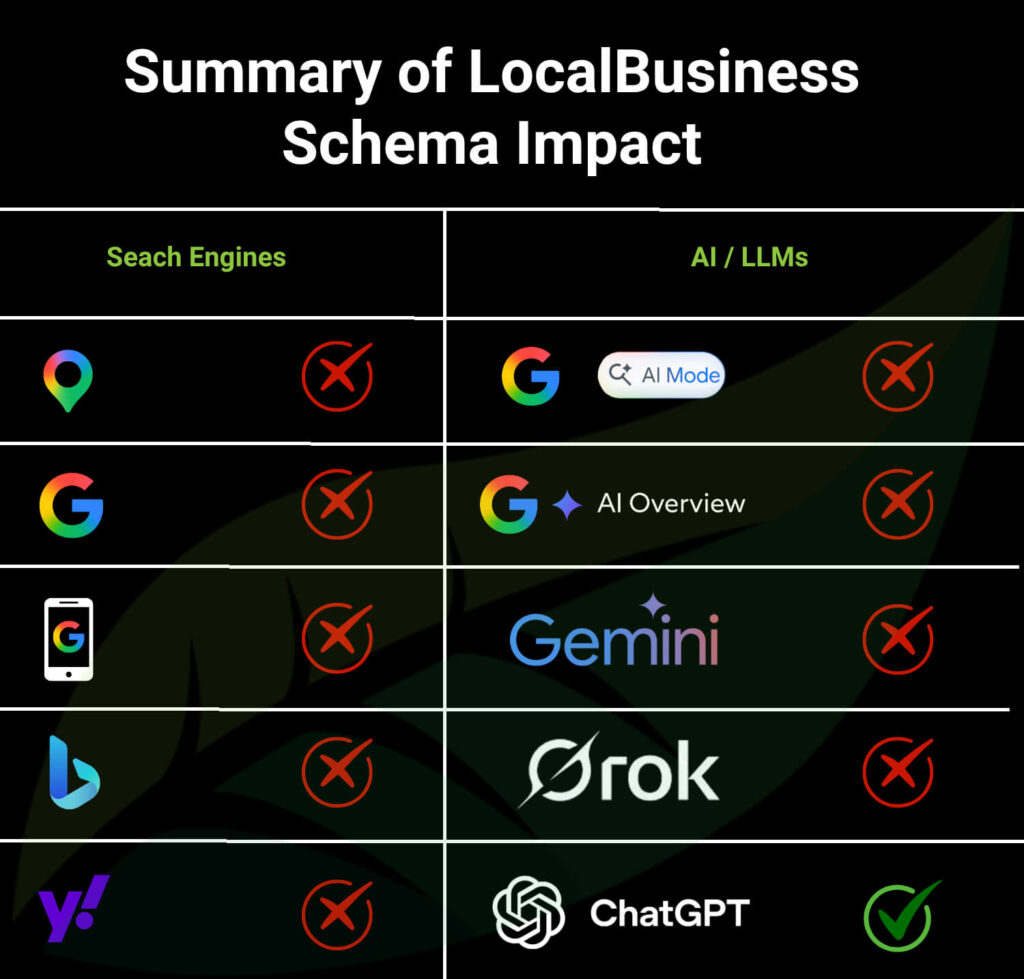
This research study reviews how adding standard LocalBusiness schema affects search engine rank and LLM recommendations for a particular business over the course of 10 weeks. During the testing period from February 27th, 2026 to April 4th, 2026, we found that LocalBusiness schema does not affect search engine results page rank, nor does it affect Google Maps rank. However, there does seem to be positive influences coming from some LLMs, including ChatGPT.
Introduction
Since 2009, schema markup has been a huge topic of discussion in the SEO community. It originally served as a way for search engines to create richer results using a standardized markup structure. Google didn’t need context to know how to display something; the structured markup dictated that.
In 2011, schema.org launched in a joint effort with Google, Bing, and Yahoo!. Schema.org became the standardized structured data to use.
Schema was never meant to be used as a signal for improved rank. It was meant to display rich results. However, when the knowledge panel historically relied on schema to display the rich result, an argument for above-the-fold real estate on page one of Google could be made, suggesting that schema markup was a vital strategy to SEO.
SEOs clung to the idea that schema was not only the golden ticket to the knowledge panel, but also something Google wanted, and by extension, an action to be rewarded with improved rank.
As time went by, SEOs began to realize that Google was getting smarter and contextualizing content into rich snippets without structured data and schema markup, which begged the question: Is schema still needed?
If you go to any SEO Reddit sub or Facebook group and ask nearly anything related to SEO ranking signals, without fail, schema markup will get thrown in there with little debate from other members.
Those who insist that schema markup influences rank never publish verifiable studies, and those who say it doesn’t matter anymore never conduct controlled environment tests to prove their reasoning. If they do, the study either lacks:
- Controlled variables
- Control vs test period
- Similarities between test subjects
- Adequate sample size
I had published a post on LinkedIn for this call to action, which reached my widest audience to date. Over 18,500 views and over 200 comments.
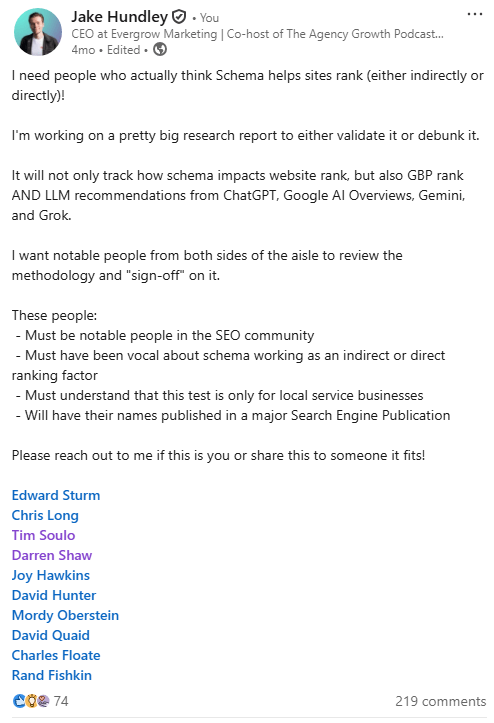
I didn’t feel like I came off leaning in one direction or the other. However, anyone who held a particular belief around schema assumed my view was the opposite. They were preemptively defending themselves.
The post blew up, and I think I had uncovered the SEO-industry’s most divisive topic.
Similar to my geotagging study we performed last year, we decided to run a similar controlled environment test to see how schema markup affects search engine rank.
We didn’t stop there.
With the explosion of AI and LLM platforms like ChatGPT, Gemini, etc, we also wanted to see how schema markup affected LLM output.
And even with prominent experiments, such as Mark Williams-Cook’s “DUCK YEAH” experiment, the SEO/GEO world was still divided.
So, we devised a test as controlled as possible to get to the bottom of it.
Peer Reviews & Acknowledgements
Expand
One of the challenges was finding people on both sides of the schema aisle to review the methodology of this study before it was conducted and the results were apparent. I wanted both doubters and hardcore believers to validate the methodology, suspending their bias.
Among the independent reviewers that answered the call to action, we had:
Jarno Van Driel
This is someone I’ve been dubbing “the grandfather of schema”. He worked directly with schema in 2008, which led him to work directly with Schema.org starting in 2011. He literally wrote the book on schema markup, specifically the schema.org markup we’re using in this study. He even works directly with the Yoast team on their schema implementation. Jarno not only reviewed the methodology you’re about to read in its entirety, but he also nitpicked the schema and ensured it was well formatted and that the most applicable types and IDs were used.
Jarno’s official stance?
Schema is valuable for contextualization and data aggregation, but does not influence search engine rank, nor LLMs.
Yoast (Alex Moss & Carolyn Shelby)
Speaking of Yoast, Edward Sturm was able to link me up with Principal SEO at Yoast, as Edward’s podcast was something we had both been on. Alex had also looped in Carolyn Shelby from the team, who is also Principal SEO over there.
Carolyn had provided the most extensive feedback on the methodology, including the reason the test was delayed by 3 weeks. We had originally planned to do a 2-week reset period in which both the Control and Test groups had no schema at all. However, she had suggested the reset period should be the same duration as the testing period.
Beyond reviewing the methodology, the role of Yoast in this study was important.
Alex and Carolyn reviewed the schema markup on each and every site in the Control and Test groups. Checking to make sure:
- Schema was accurate
- All sites had schema removed during the reset period
- Only the sites in the Test Group had the required schema during the testing period
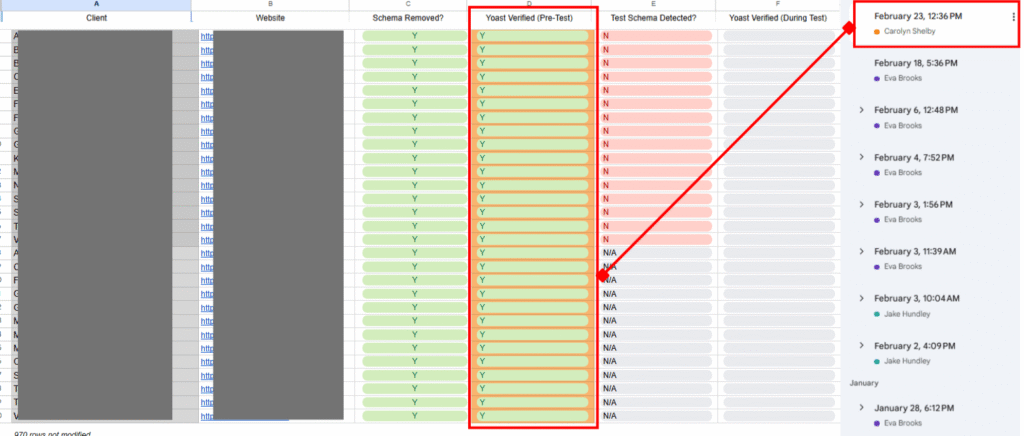
Huge thank you to Alex, Carolyn, and Yoast on this one.
Alex and Carolyn’s official stance?
I’m honestly not sure. They seemed pretty independent; however, Yoast seems to take a stance in their documentation suggesting that it doesn’t help with search engine rank, only visibility, and that schema helps your site be understood by AI platforms.
Terry Samuels
Terry Samuels is the one staunch advocate of schema I got to review the methodology and meet with me over video call.
He’s been a technical SEO specialist for the last 30 years, running his own website and SEO agency, Salterra, for the last 15 years. Terry believes, through his own tests, that highly detailed structured data is necessary for search engines to know exactly what a business is and what they do, and why it holds authority.
Terry’s official stance?
“Advanced” schema is absolutely necessary in an SEO strategy.
David Quaid & Edward Sturm
I grouped these guys together because they’ve become a dynamic duo on Edward’s podcast.
Edward has become a notable name in the SEO community with his daily SEO show and short content. He’s consulted with Microsoft, P&G, Time, and more
David is a B2B SEO Growth Strategy Advisor specifically in SEO and PPC. He’s owned Primary Position since 2004. David’s an ultra-white hat SEO that puts his SEO theories to test and public critique (including my own). He spends his spare time managing one of the world’s largest SEO communities or guesting on other SEO podcasts.
David and Edward’s official stance?
Schema doesn’t impact rank. The most it does is qualify you for rich snippets and results. David also clarifies on this that some industries make schema a necessity, like travel and employment.
David Hunter
David Hunter is the founder and CEO of Epic Web Studios and LocalFalcon, the original local SEO geogrid tool, who graciously provided the credits required for this study. The entire reason this study happened is because of the discussion Cody and I had with him on our Agency Growth Podcast.
HUGE shoutout to David for helping with this study.
I also have to shout out his comment on the original methodology document, which gave me confidence to get more people involved.

David’s official stance?
David mentioned on his episode that he doesn’t think schema has anything to do with rank but thinks there is something to how schema is used in LLMs.
MOZ (Jonathan Berthold & Tom Capper)
LocalFalcon covered my local SEO need, but I needed SERP tracking help. That’s when, yet again, Edward Sturm connected me with Moz’ VP of Revenue, Jonathan Berthold, as both being alumni from Edward’s show. Jonathan then looped in Moz’s Director of Search Product Strategy, Tom Capper, to also review the methodology and give it the pushback it needed to be the best schema study out there.
I have to hand it to these guys and Moz. I don’t think they sleep. Every email got answered within a few minutes, no matter the time of day.
These guys hooked us up with a Moz Pro subscription and the white-glove treatment on setting up the SERP test within Moz.
Jonathan and Tom’s official stance?
Schema doesn’t impact rank, and they’re skeptical on LLMs.
Other Peer Reviewers and Honorable Mentions
Special shoutout to some other notable people who requested to review the methodology:
- Darren Shaw with Whitespark
- Joy Hawkins with Sterling Sky
Darren and Joy both share the same view. They’ve done their own tests on schema, and nothing has really indicated an increase in rank.
I would have loved to have Tim Soulo from Ahrefs review the methodology, but he’s been ignoring my emails since we had him on our podcast.
Also, Matt Diggity just outright refused to partake. Why, Matt? Don’t you love schema?
Methodology
Pulling off this test was no easy feat. It required multiple pages of planning methodology, independent, third-party reviewers, and the schema we used. For that reason, the methodology is condensed here to a collapsible toggle. It’s there for you if you would like to review it; otherwise, feel free to skip to the results.
Pre-Test & Client Sorting
Pre-Test & Client Sorting
29 Clients (domains) with a total of 36 locations were selected. All within the same general industry (landscaping, lawn care, outdoor services). In our industry, we simply refer to this as the “Green Industry.”
Clients were sorted into two groups
- Control Group
- Test Group
All clients are located within the United States.
The groups were sorted based on geographic similarities to mitigate location and climate disparities and bias.
Control Group Domains (13)
- 6 South
- 3 Northeast
- 3 Midwest
- 1 West
Control Group GBP Locations (18)
- 6 South
- 3 Northeast
- 8 Midwest
- 1 West
Test Group Domains (16)
- 6 South
- 3 Northeast
- 6 Midwest
- 1 West
Test Group GBP Locations (18)
- 6 South
- 3 Northeast
- 8 Midwest
- 1 West
Additionally, clients who had started working with us in the last 6 months would not be included in this study. Initial efforts and site rebuilds that are relatively new cannot be considered due to potentially new rank delays from massive content and structural shifts.
Environment Cleaning & Benchmarking
Environment Cleaning & Benchmarking
All websites were scrubbed of any structured data and verified with Schema.org’s Schema Markup Validator.
All websites use Yoast SEO, which is the only element out of the plugins and themes used on our client sites that adds schema to the site. In version 26.8 of Yoast, we were able to toggle off the entire schema framework and validate that no schema was detected on sites whatsoever.
We had Yoast themselves validate this on all sites.
We then ensured all sites had a record of a Google Search Console crawl report after the schema was removed.
Control & Test Periods
Control & Test Periods
A control period of 5 weeks was established to give time for sites and potential rankings to level out from any potential influences to prepare for this test. Simple things like the act of removing all schema.
Absolutely nothing related to the client’s SEO was touched during this period.
Following the Control period, a test period would commence, which would be the core of the test. It spanned 5 weeks and officially split the Control and Test Groups apart.
The Control Group continued to have nothing done to their SEO during the 5-week period.
The Test Group would have “advanced” LocalBusiness schema placed on their home pages.
Schema Placed
Schema Placed
The schema below is an example of the same template we used for each client. All personal details have been removed.
Some details have been kept, such as hours of operation. This provides transparency on what formatting was used for things like OpeningHoursSpecification.
Additionally, some elements were consistent across all clients, such as the HomeAndConstruction type and the values for the NAICS and ISICv4 properties.
        <script type="application/ld+json">
        {
          "@context": "https://schema.org",
          "@graph": [
            {
              "@type": "HomeAndConstructionBusiness",
              "@id": "https://[clientdomain]/#organization",
              "name": "[client business name]",
              "legalName": "[client legal business name]",
              "mainEntityOfPage": {
                "@id": "https://[clientdomain]/#webpage"
              },
              "url": "https://[clientdomain]/",
              "logo": "https://[clientdomain/wp-content/uploads/client_logo.png]",
              "description": "Professional [description] services in the [target area].",
              "telephone": "+1-xxx-xxx-xxxx",
              "email": "[email]@[clientdomain]",
              "naics": "561730",
              "isicV4": "8130",

              "address": {
                "@type": "PostalAddress",
                "streetAddress": "[address",
                "addressLocality": "[city]",
                "addressRegion": "[state]",
                "postalCode": "[zip]",
                "addressCountry": "US"
              },

              "hasMap": "[google map link]",

              "geo": {
                "@type": "GeoCoordinates",
                "latitude": 	xx.xxxxx,
                "longitude": -xx.xxxxx
              },

              "areaServed": [
                {
                  "@type": "City",
                  "name": "[city]",
                  "containedInPlace": {
                    "@type": "AdministrativeArea",
                    "name": "[state abrreviation]"
                  }
                },
                {
                  "@type": "City",
                  "name": "[city #2]",
                  "containedInPlace": {
                    "@type": "AdministrativeArea",
                    "name": "[state abbreviation]"
                  }
                },
                {
                  "@type": "City",
                  "name": "[city #3]",
                  "containedInPlace": {
                    "@type": "AdministrativeArea",
                    "name": "[state abbreviation]"
                  }
                }
              ],

              "sameAs": [
  "https://www.facebook.com/[clientpage]",
                "https://share.google/[gbplink]",
                "https://www.yelp.com/biz/[yelpprofile]",
                "https://www.instagram.com/[igprofile]",
                "https://nextdoor.com/pages/[nextdoorprofile]",
                "https://www.bbb.org/us/[bbbprofile]",
                "https://www.mapquest.com/us/[mapquestprofile]",
                "https://www.dnb.com/business-directory/company-profiles.[clientprofile]",
                "https://[local city top 100 profile",
                "https://www.glassdoor.co.nz/Location/[glassdoorprofile]",
                "https://yellow-pages.us.com/[yellowpagesprofile]"
              ],

              "openingHoursSpecification": [
                {
                  "@type": "OpeningHoursSpecification",
                  "dayOfWeek": ["Monday", "Tuesday", "Wednesday", "Thursday", "Friday"],
                  "opens": "07:00",
                  "closes": "17:30"
                },
                {
                  "@type": "OpeningHoursSpecification",
                  "dayOfWeek": "Saturday",
                  "opens": "08:00",
                  "closes": "12:00"
                },
                {
                  "@type": "OpeningHoursSpecification",
                  "dayOfWeek": "Sunday",
                  "opens": "00:00",
                  "closes": "00:00"
                }
              ],

              "hasOfferCatalog": [
                {
                  "@type": "OfferCatalog",
                  "name": "Lawn Care Services",
                  "itemListElement": [
                    {
                      "@type": "Offer",
                      "itemOffered": {
                        "@type": "Service",
                        "name": "Lawn Fertilization",
                        "description": "[brief description]"
                      }
                    },
                    {
                      "@type": "Offer",
                      "itemOffered": {
                        "@type": "Service",
                        "name": "Weed Control",
                        "description": "[brief description]"
                      }
                    },
                    {
                      "@type": "Offer",
                      "itemOffered": {
                        "@type": "Service",
                        "name": "Aeration",
                        "description": "[brief description]"
                      }
                    },
                    {
                      "@type": "Offer",
                      "itemOffered": {
                        "@type": "Service",
                        "name": "Soil Tests & Amendments",
                        "description": "[brief description]"
                      }
                    },
                    {
                      "@type": "Offer",
                      "itemOffered": {
                        "@type": "Service",
                        "name": "Insect & Pest Control",
                        "description": "[brief description]"
                      }
                    },
                    {
                      "@type": "Offer",
                      "itemOffered": {
                        "@type": "Service",
                        "name": "Fungus & Disease Control",
                        "description": "[brief description]"
                      }
                    }
                  ]
                }
              ]
            },
            {
              "@type": "WebPage",
              "@id": "https://[clientdomain]/#webpage",
              "url": "https://[clientdomain]/",
              "name": "[client name] | [location]",
              "isPartOf": {
                "@id": "https://[clientdomain]/#website"
              }
            },
            {
              "@type": "WebSite",
              "@id": "https://[clientdomain]/#website",
              "url": "https://[clientdomain]/",
              "name": "[clientname]",
              "inLanguage": "en-US",
              "publisher": {
                "@id": "[clientdomain]/#organization"
              }
            }
          ]
        }
        </script>
Considerations
Considerations
The LocalBusiness schema above was only placed on the home page of a client’s website in accordance with Google’s general structured data guidelines.
“Schema Impacts Rank” Not “Which Schema Impacts Rank”
The aim of this outcome is to elicit a simple yes or no answer. To accomplish this, the test needed to focus on standard, non-rich-snippet-producing schema.
If schema did impact rank, then a separate test for “which schema impacts rank” would be considered.
Article, Author, and Other Schema Types Will Not Be Used
Not all clients have a robust blog or a blog at all, which includes authors or other relevant options to add this schema. Adding a blog and authors to each site would skew the results and result in inconclusiveness due to a lack of variable isolation with the added content.
Review Markup Will Not Be Used
Simply put, in most cases, adding review markup schema to a local business site goes against Google’s guidelines.

For the safety and future success of our clients, we will avoid this.

FAQ Schema Will Not Be Used
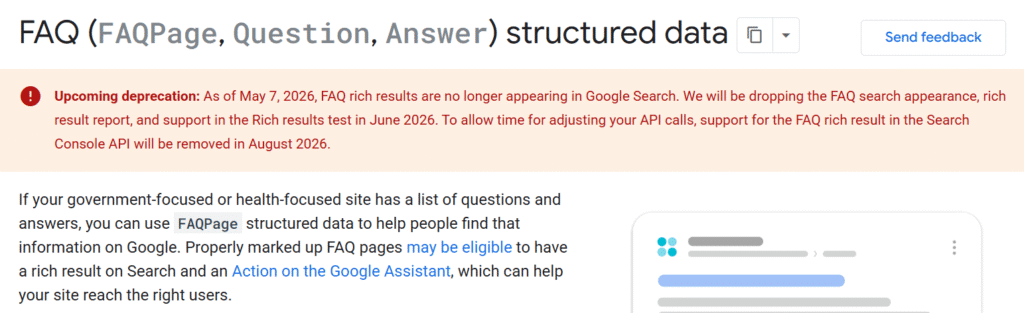
Google eliminated the ability for FAQs to show in rich results in 2023, except for government or health-related organizations.
Shortly after this test concluded, Google announced the deprecation of FAQ rich snippets altogether on May 7th, 2026.
Some will argue that doesn’t mean FAQ schema is no longer important. My rebuttal would be if Google no longer needs it to show rich results, then why is it needed at all?
Rich Snippets To Be Avoided
An argument can be made for schema that it can indirectly improve rank by improving click-through-rate via rich snippets. For the purpose of this test, our schema implementation is designed to avoid all rich snippets, including breadcrumbs.
Whether schema markup influences CTR and by how much is to be the subject of a different test.
Search Engines & LLMs Tested
Search Engines and LLMS Tested
There were two primary tools used for this study.
Moz Pro for SERP analysis on the following search engines:
- Google Mobile
- Bing
- Yahoo!
LocalFalcon for Google Maps and LLM analysis on the following:
- Google Maps
- Google AI Mode
- Google AI Overviews
- Gemini
- Grok
- ChatGPT
Queries & Metrics Tracked
Queries & Metrics Tracked
The entirety of the test reviewed rank and placement of two queries:
Query #1
“[service] company in [target location]”
Query #2
“can you recommend a [service] company that services the [location] area that’s open at noon on friday?”
Query #1 was the primary target for SERP analysis, but we wanted to see if search engines behaved differently when longer queries were used that called for objective information. Objective information that can be found in schema.
Query #2 was also a topic of interest for the LLM testing side of things with LocalFalcon. It was also included in the SERP analysis for research consistency.
After the 5-week control period, during which schema was stripped from all sites and SEO efforts were halted, a benchmark report was conducted on the final week of the 5-week control period on all platforms and tools. After which, the LocalBusiness schema was added to all Test Group sites, and Google Search Console crawl reports were validated after the fact to ensure the home pages had been recrawled and indexed.
The results would be captured and plotted for each client, for each keyword, and each platform week-over-week.
*The week-over-week data capture was merely a failsafe to ensure there weren’t any reporting issues throughout the 5-week testing period. Because we had this failsafe in place, it actually caused us to switch benchmarking for LocalFalcon to Friday, February 27th, instead of the originally planned Wednesday, the 25th. For some reason, Grok was not recording results on Wednesdays but would output answers sufficient for data collection on Fridays.
SERP Testing with Moz Pro
SERP results were captured using Moz Pro. One campaign was created for each client in the test, which tracked the average position of both of our target keywords week over week across the four search engines.
Both average rank and Search Visibility would be plotted each week until the end of the 5-week testing period.
As a refresher:
- Rank
- The position our client is in for their target keyword in the organic results (aside from the Mapp pack).
- Search Visibility
- The total estimated percentage of clicks the client is likely to get based on their organic ranking positions for all tracked keywords.
No other SEO changes would take place on any domain or GBP.
Google Maps & LLM Testing with LocalFalcon
To determine local rank and local recommendations by LLMs, we used a 9×9 grid and tested each query at each plot point weekly.
That’s:
- 2 Queries
- x81 Plot points
- x36 GBP locations
- x6 Weeks (includes the benchmark week)
- x6 Environments
Each query for each client on each platform received 486 searches throughout the 6-week period.
Due to LocalFalcon’s advanced brand and entity recognition, an LLM “rank” metric can be used in this test.
Similar to the testing methodology with Moz, we set up 36 individual campaigns and monitored them week over week, capturing the final results on April 3rd, 2026.
During this 5-week testing period (plus the benchmark week), we reviewed the average results from three primary metrics on all platforms:
- Average Total Rank Position (ATRP)
- Measures the average total rank of all 81 query searches in the gridded target area.
- Share of Local / AI Voice (SoLV / SAIV)
- SoLV measures the overall percentage your brand appears in the top three Google Maps results for the query you’re targeting. SAIV essentially does the same thing for AI / LLM recommendations. The only difference is it doesn’t count whether you’re in the top three or not. It is whether your brand is included in the recommendation or not, and the percentage at which it does.
Analyzing the Results
Analyzing the Results
Most studies will simply suggest that if the average rank of the Test Group improved over the average rank of the Control Group, then the variable in the Test Group was the root cause. However, that is an oversimplification and doesn’t account for uncontrollable factors between the groups.
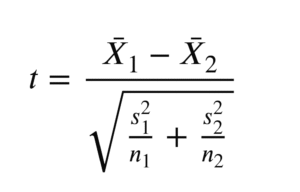
In order to be confident in the analysis between the groups, a One-Tailed Welch’s Two-Sample T-Test was conducted between the deltas of each and every client’s benchmark result against their final result to determine a degree of confidence.
If the Test Group outperformed the Control Group by 3 positions, the T-test will indicate how mathematically confident we are that the schema was the result of the change in the Test Group over the Control Group.
One thing we have to consider is that the one-tailed T-test only detects confidence in change and not improvement. For this test, we only want to know if an improvement happened.
This means that the average increase of the rank over the 5-week period must be greater in the Test Group than the Control Group in order to consider running the test.
If the Test Group did not outperform the Control Group, then we have to assume that the variable (schema) had no impact, and we place a “0%” in the confidence field.
If the Test Group does outperform the control group and a T-test is run, we must accept a 90% or higher confidence percentage to make definitive claims that the schema was the cause of the improvement.
For purposes of understanding the confidence level, 50% is akin to a coin flip and is not statistically significant. The same can be true for anything between 25% and 75%. As a marketer considering realtively low effort tasks with no real downsides, I’ll generally accept something at 80% for my own efforts but will not promote anything under 90% as fact.
My rule of thumb:
- <50% = “No.”
- 50%><80% = “Probably not.”
- 80%><90% = “Maybe. Why not? But focus on other things first.”
- >90% = “Yes. You should do this.”
One-Tailed Welch’s Two-Sampled T-Test
The formula for this is expressed like this:
In our Google Sheet, this is what the formula looks like:
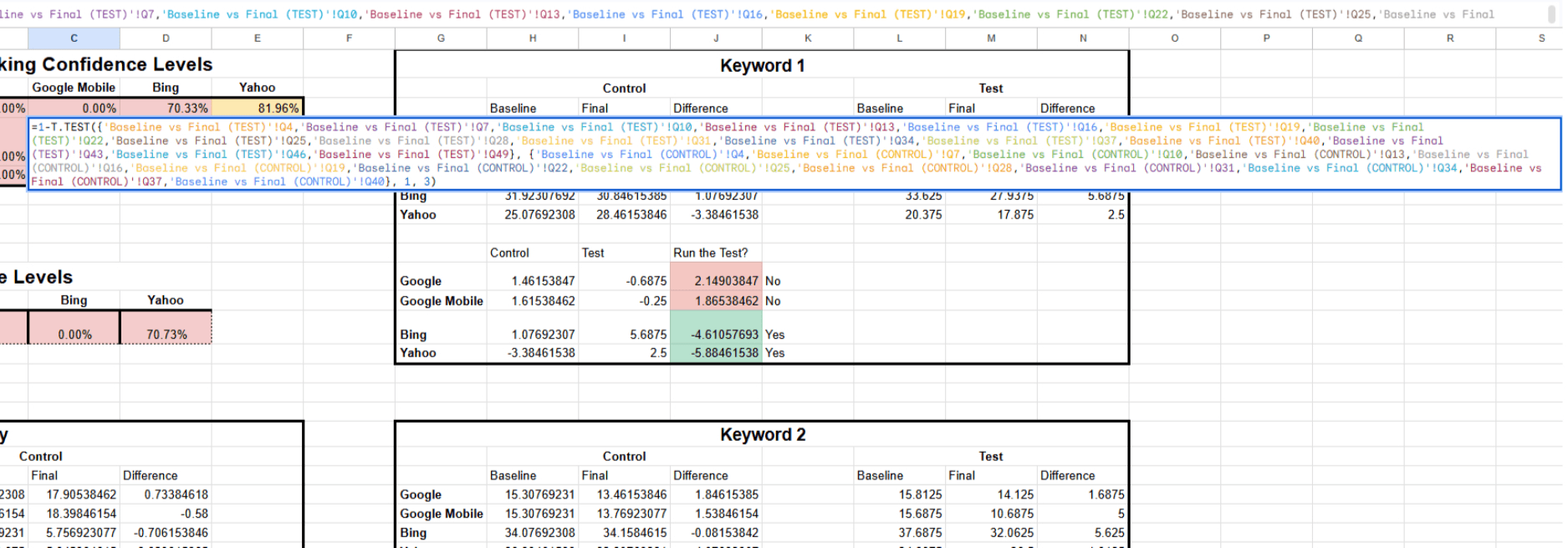
The numbers are pulled from the deltas of the benchmark and final results of each individual client in the Control Group and are run against the Test Group deltas. This is how the confidence levels are determined.
Keep in mind that a 0% means the average of the test group did not perform better than the average of the Control Group during the testing period, and a null 0% was entered.
Potential Criticisms
Potential Criticisms
Any information presented to people that is contrary to their existing beliefs and expectations is met with trepidation and is subject to additional scrutiny.
This section aims to address those based on my own observations.
Only Testing Local Service Area Businesses in One Industry
Testing by isolating one specific industry is the best way to test. That is, removing the industry variable as schema could also affect industries differently. If there was an industry mix in the control and test groups, that could skew the data.
I welcome people to “steal” this methodology and test it on other industries.
This conclusion to this test will stress the importance or lack thereof of structured data markup for a particular industry.
Not Using All Possible Structured Data
This too could skew the results, as some clients and businesses do not have some features others have. The structured data chosen was data relevant to all businesses.
Additionally, the aim of the test is to extract a simple, boolean answer, not an array of which schema affects rank.
Algorithms Change Over Time and Will Influence Results
This is why the groups are split into a control group and test group.
The groups will move in parallel through time and algorithm updates. If both groups increase rank, the question becomes, “Did one group increase more in rank than the other?” The opposite direction would be true as well.
Seasonality of Industry
The landscaping industry sees a pretty heavy seasonal change heading into Q2. CTRs, impressions, and even rank can be influenced strictly by an increase in localized demand.
Again, the test and control groups solve for this.
In addition, structuring each group so they share geographic similarities reduces the variance in weather and climate influences on the total sample sizes.
Uncontrollable Factors
Although we manage the website and SEO for all clients in this study and are consciously halting all SEO efforts, there are still uncontrollable factors.
These factors include things like:
- Review quantity, frequency, and ratings
- Social media influences
- Local influences
- Competitor influences
- etc
This is the reason the Welch test is being used. It was specifically designed for real-world variance between two groups.
My Hypothesis Presents a Bias
Many people know my views on schema, and some may believe that this test or the results can be manipulated to seek the answer I desire.
However, I have four points to this:
- This methodology is public.
- This methodology has been peer-reviewed by members of varying beliefs and positions related to schema prior to the release of the results.
- The schema used and placed on the sites (or lack thereof in the Control Group) was reviewed and validated by Alex Moss and Carolyn Shelby of Yoast throughout the test.
- I would love for the antithesis to be proven.
The final point is the most important.
Our agency does not currently implement schema on our client websites. If schema does, in fact, show promise or significant influence on search and LLMs, then this adds value to our service by way of including this line item.
… and the study to prove it.
SERP Ranking Results with Moz Pro
The test for SERP benchmarking started on February 25th, 2026, where we benchmarked individual and average positions for our two target keyword phrases using Moz Pro for both the control group and the test group.
The nice thing about Moz is that we can track rank and search visibility in multiple search engines and put all of them to the test. Especially considering Bing’s Principal Product Manager, Fabrice Canel, confirmed they use schema in their LLMs to help understand content on LinkedIn.
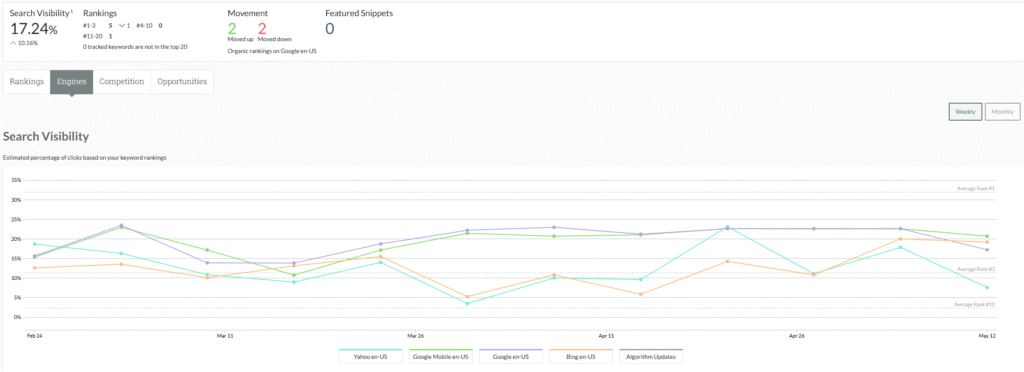
For the purposes of this part of the test, I only focused on Question #1. Question #2 was geared towards the LLM and AI visibility we’ll cover later using a different tool.
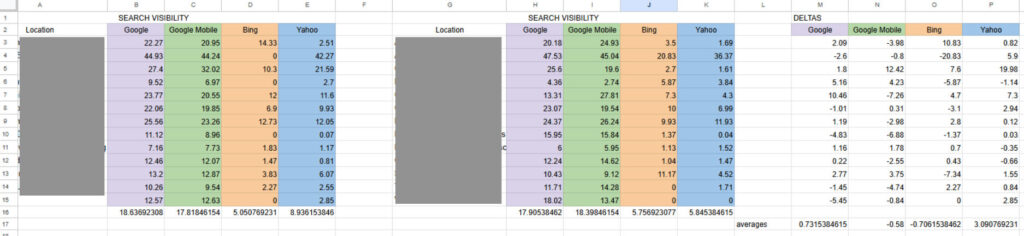
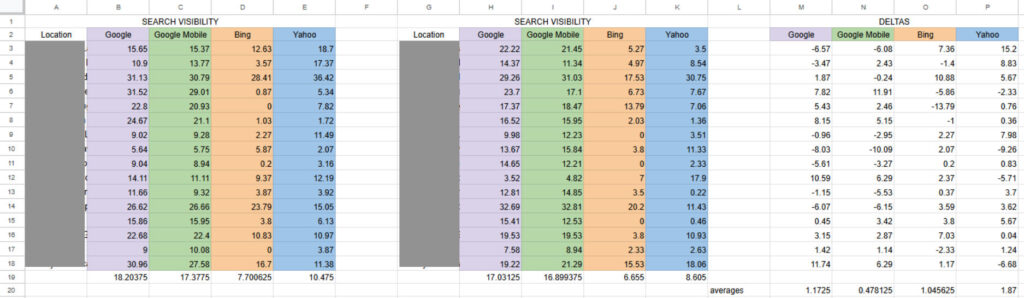
- Purple = Google
- Green = Google Mobile
- Orange = Bing
- Blue = Yahoo
- Question 1 = “[service] company in [target city]”
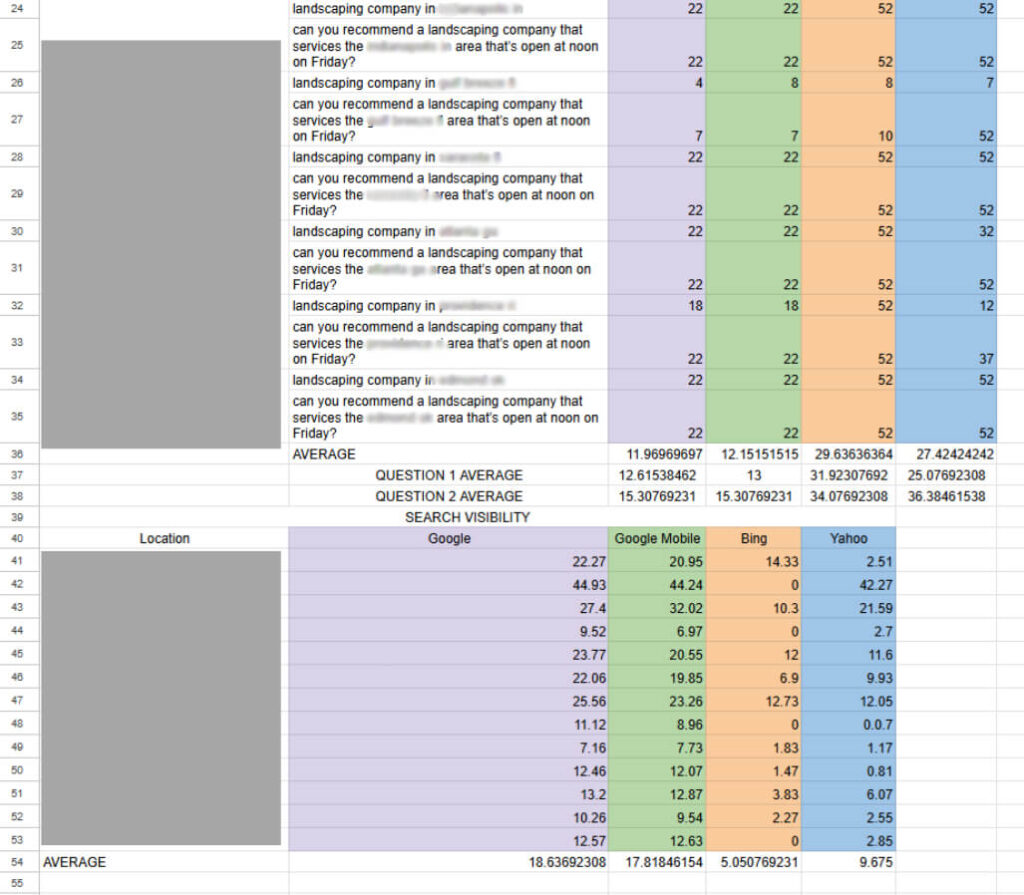
The average benchmarking results for the control and test groups for the search query “[service] company in [target city]” were as follows:
Control Group Query Rank Benchmark
- Google: 12.62
- Google Mobile: 13
- Bing: 31.92
- Yahoo: 25.08
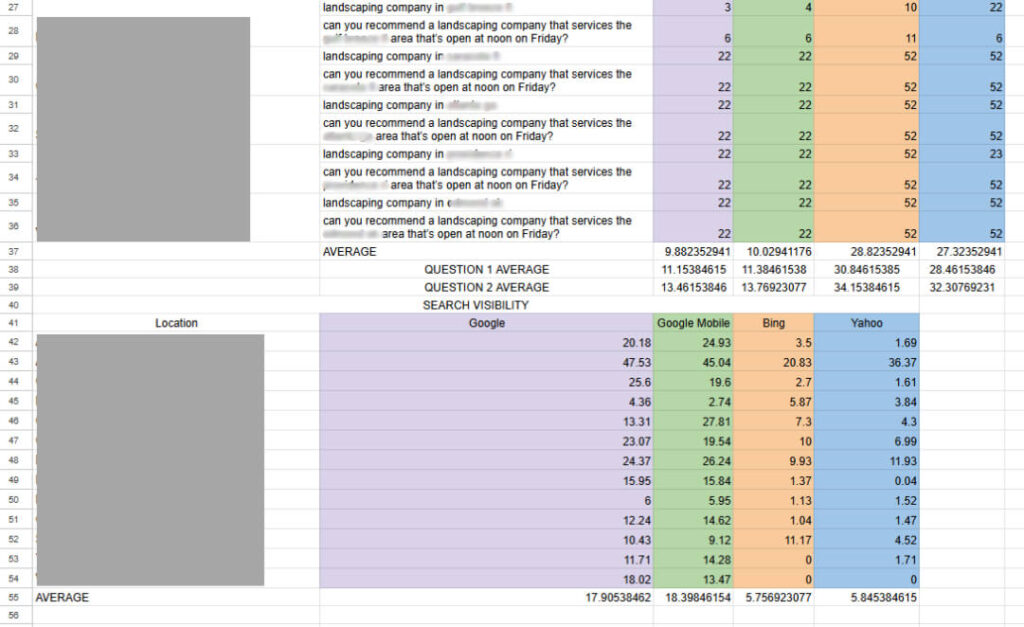
Control Group Query Rank Final
- Google: 11.15
- Google Mobile: 11.38
- Bing: 30.85
- Yahoo: 28.46
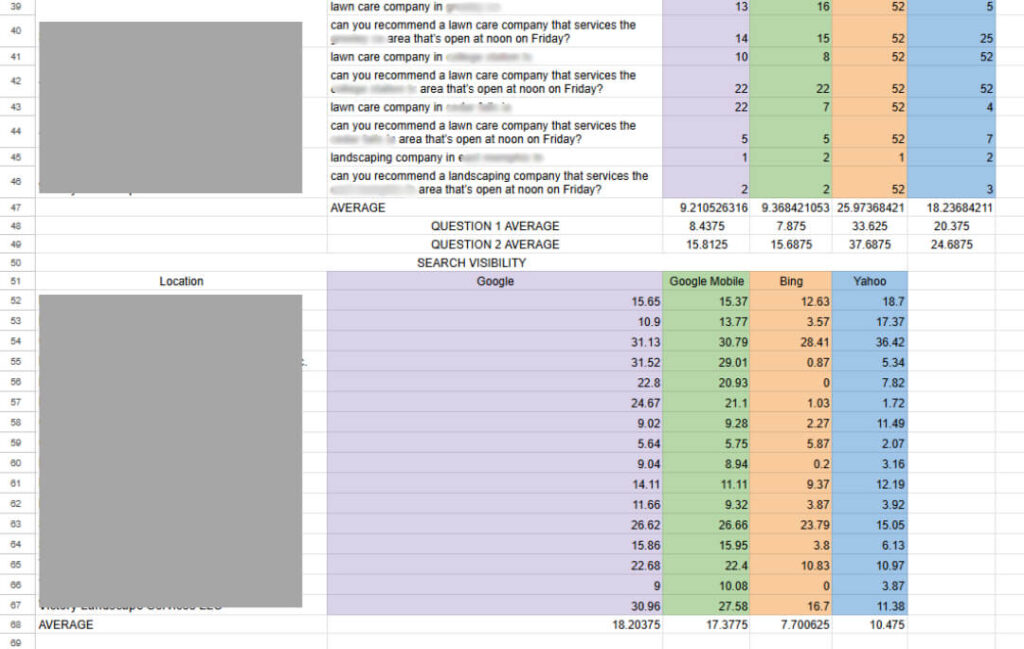
Test Group Query Rank Benchmark
- Google: 8.44
- Google Mobile: 7.88
- Bing: 33.63
- Yahoo: 20.36
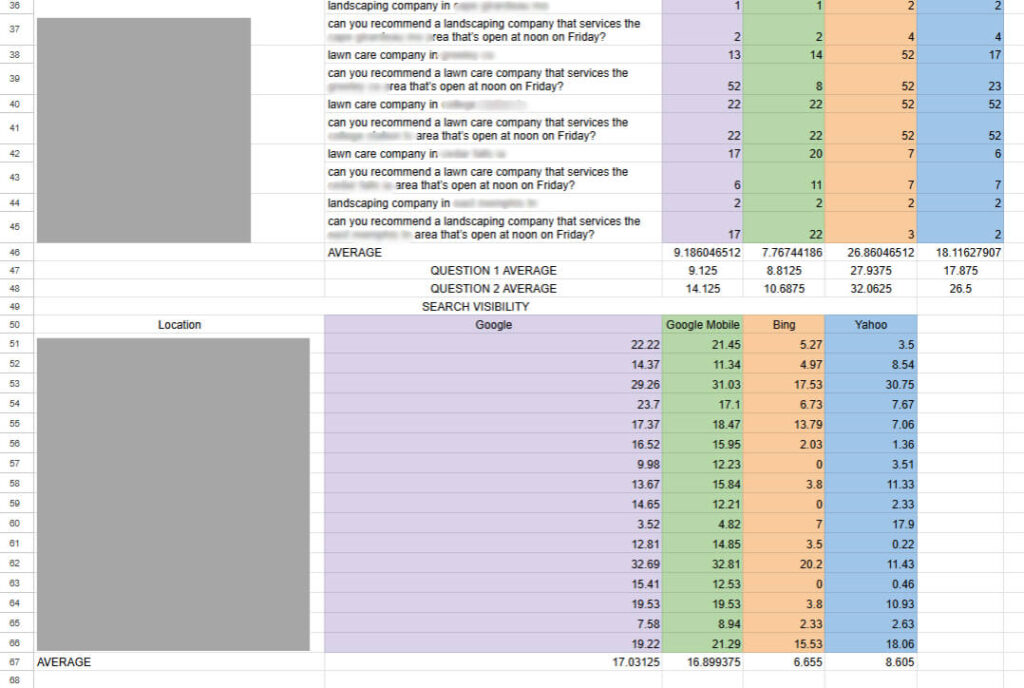
Test Group Query Rank Final
- Google: 9.13
- Google Mobile: 8.81
- Bing: 27.94
- Yahoo: 17.88
We also benchmarked the overall search visibility using Moz Pro with the following average benchmarks:
Control Group Search Visibility Benchmark
- Google: 18.64
- Google Mobile: 17.82
- Bing: 5.05
- Yahoo: 9.68
Control Group Search Visibility Final
- Google: 17.91
- Google Mobile: 18.40
- Bing: 5.76
- Yahoo: 5.86
Test Group Search Visibility Benchmark
- Google: 18.20
- Google Mobile: 17.38
- Bing: 7.7
- Yahoo: 10.48
Test Group Search Visibility Final
- Google: 17.03
- Google Mobile: 16.90
- Bing: 6.66
- Yahoo: 8.61
Once we had the benchmark averages for each target query and the final week’s numbers for both the control and test groups, we could run the Confidence T-Test.
However, due to some basic logic, we shouldn’t actually run the T-test on every control vs test scenario.
If you run a standard T-test on all data sets, it will only tell you, with confidence percentages, how likely the results are to change. Period.
That’s not what we’re looking for. We’re looking to see how confident we are that the schema positively changed over the control group.
In other words, if the test group dropped 5 positions while the control group increased 5 positions, the T-test would likely tell me that there is high confidence that schema impacted rank… but not positively. What we have to consider instead is that before we run the T-test, we need to ensure that the schema test group averages saw a higher rank increase -OR- a smaller rank decrease than the control group.
If the control group increased by 5 positions, but the schema test group increased by 5.5 positions, we can run the test. On the flip side, if the control group decreased by 5 positions but the schema test group only decreased by 4 positions, we can still run the test. The theory being that the schema shielded the rank drop that the control group saw.
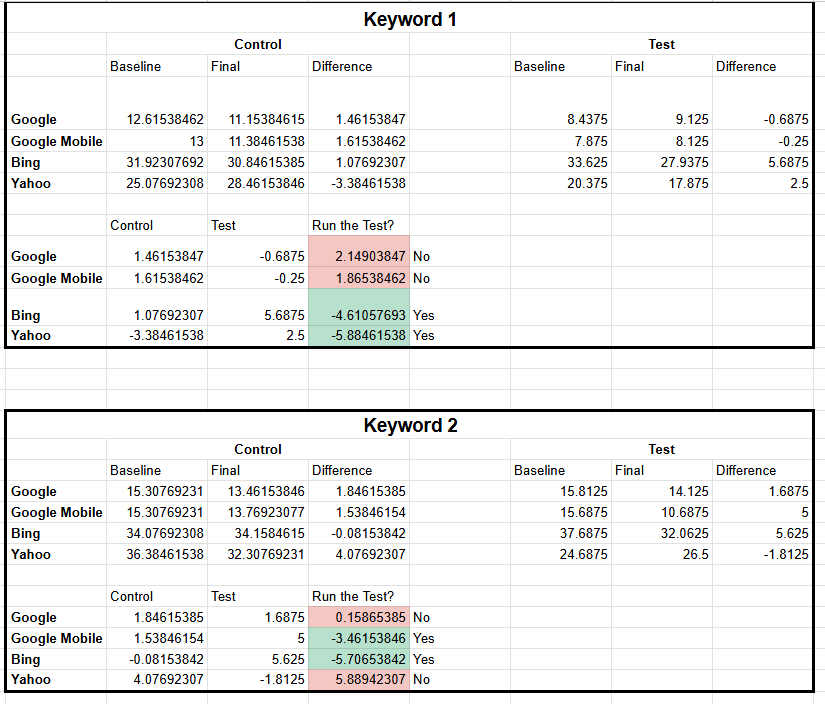
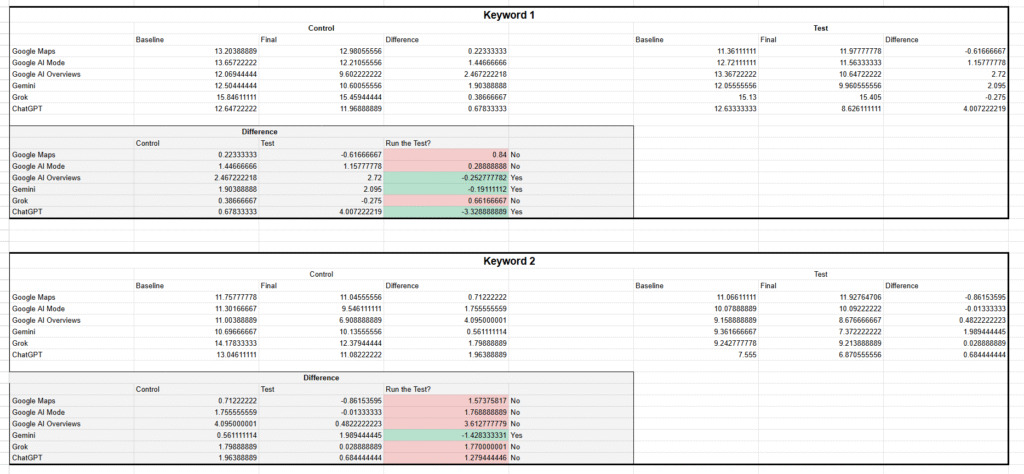
In the image above, a positive number in the “Difference” column indicates a rank improvement. Going from 15 to 13 would be +2. A negative would show that rank was lost.
If you look at Keyword 1 under “Run the Test?”, you’ll see that the control group gained 1.46 positions during the 5-week period, but the schema test group lost 0.69 positions, meaning the control group outperformed the test group by 2.15 positions.
Therefore, it doesn’t make logical sense to run the T-test. We can conclude that schema did not affect this scenario.
The colored “Run the Test?” column indicates we can run the test if the difference between the Control column and the test column is negative.
If you look at the intersection of “Bing” and “Run the Test?”, we see that “-4.61057693”. That negative number indicates that the Control Group performed 4.61 positions worse than the Test Group… or… the Test Group performed 4.61 positions better, so we should run the test.
This is where it gets weird for looking at Search Visibility. Since Search Visibility is expressed as a percentage where “improvements” mean a higher number, versus rank, where “improvements” mean a lower number, the logic is then flipped.
Positive numbers in the “Run the Test?” column for percentage-based metrics would indicate the T-test should be run.
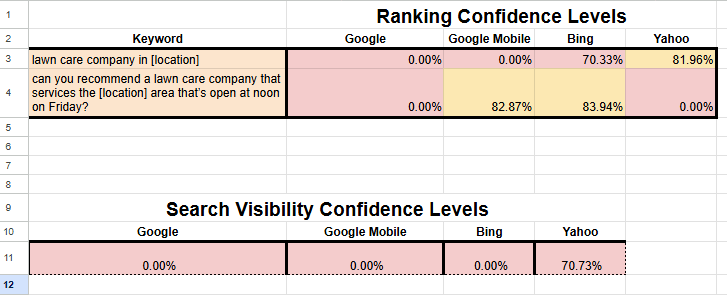
Here were the results of the confidence tests for SERP results:
SERP Conclusions
Here are the results broken out by keyword and search engine.
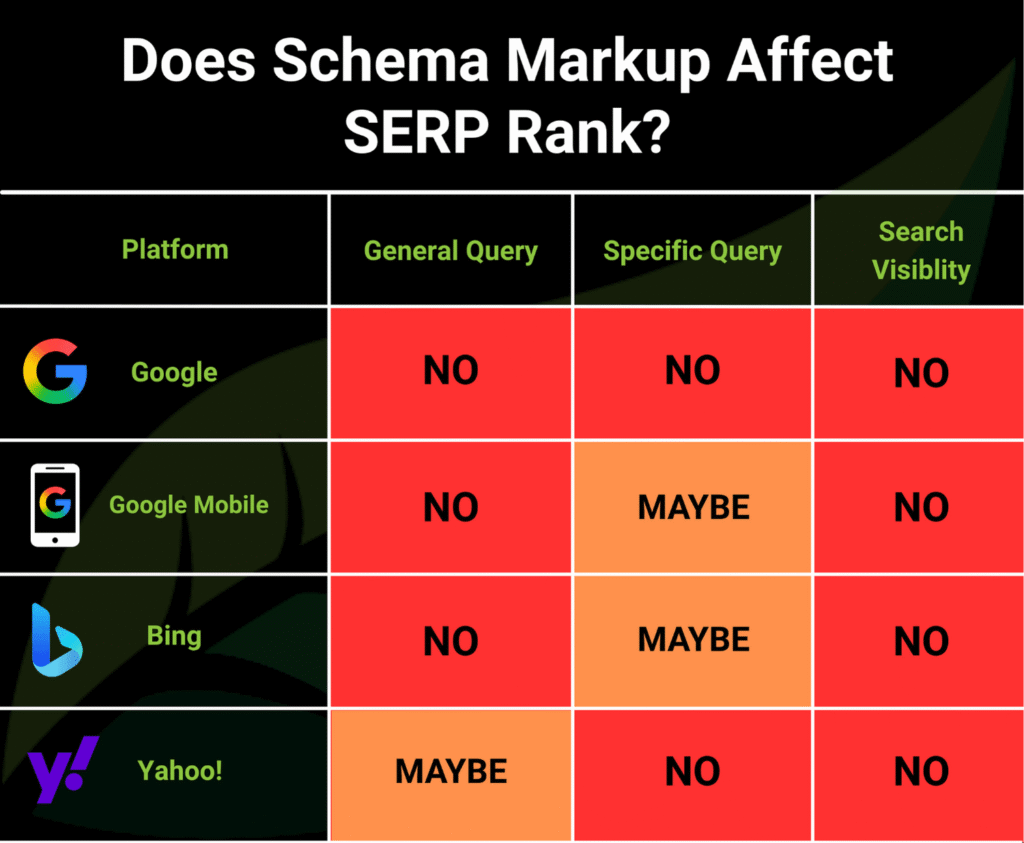
Query #1: “[service] company in [location]”
LocalBusiness schema does not impact ranking on any search engine, nor does it impact overall search visibility.
Yahoo! was the only search engine that stood out as having a higher confidence level, but most statisticians would argue anything under 85% confidence isn’t strong enough.
Query #2: “can you recommend a lawn care company that services the [location] area that’s open at noon on friday”
LocalBusiness schema does not impact ranking for these types of queries or overall search visibility.
Google Mobile and Bing saw higher confidence levels, but both are still under 85%.
Final Verdict
LocalBusiness schema is overall not valuable for improving the search engine rank of your local business website.
Don’t let self-proclaimed technical SEO specialists try to upsell this as a necessary component to your rank. The hype is snake oil.

Google Maps Results with LocalFalcon
The benchmark started 2 days after the Moz benchmarking on February 27th, and the test concluded on April 3rd.
The only query we cared about testing for Google Maps was Query #1, “[service] company in [location]”.
We ran the test for Query #2 as well, with (spoiler alert) the same results. I’ll share both here because more information is better than less.
Control Group Change
Control Group Benchmark for Google Maps Rank
- Query #1: Average Position 13.2
- Query #2: Average Position 11.76
Control Group Final for Google Maps Rank
- Query #1: Average Position 12.98
- Query #2: Average Position 11.05
Overall, the control group improved positions by doing nothing, which can be explained by algorithmic updates thinning competition. The real test is when it’s stacked up to the test group performance.
Test Group Change
Test Group Benchmark for Google Maps Rank
- Query #1: Average Position 11.36
- Query #2: Average Position 11.07
Test Group Final for Google Maps Rank
- Query #1: Average Position 11.98
- Query #2: Average Position 11.93
In both query tests, the Control Group outperformed the Test Group. Because of this, a confidence T-test isn’t applicable. This indicates that LocalBusiness schema has absolutely no effect on Google Maps ranking.
One other thing we looked at with LocalFalcon was Share of Local Voice (SOLV).
“Does LocalBusiness schema impact how often your brand will show up in LLMs?“
Here were the results:
SOLV Control Group Change
Control Group Benchmark for Google Maps Rank
- Query #1 Average SOLV: 26.68%
- Query #2 Average SOLV: 28.19%
Control Group Final for Google Maps Rank
- Query #1 Average SOLV: 25.17%
- Query #2 Average SOLV: 31.83%
Overall, the control group improved positions by doing nothing, which can be explained by algorithmic updates thinning competition. The real test is when it’s stacked up to the test group performance.
SOLV Test Group Change
Test Group Benchmark for Google Maps Rank
- Query #1 Average SOLV: 25.87%
- Query #2 Average SOLV: 28.39%
Test Group Final for Google Maps Rank
- Query #1 Average SOLV: 24.55%
- Query #2 Average SOLV: 28.46%
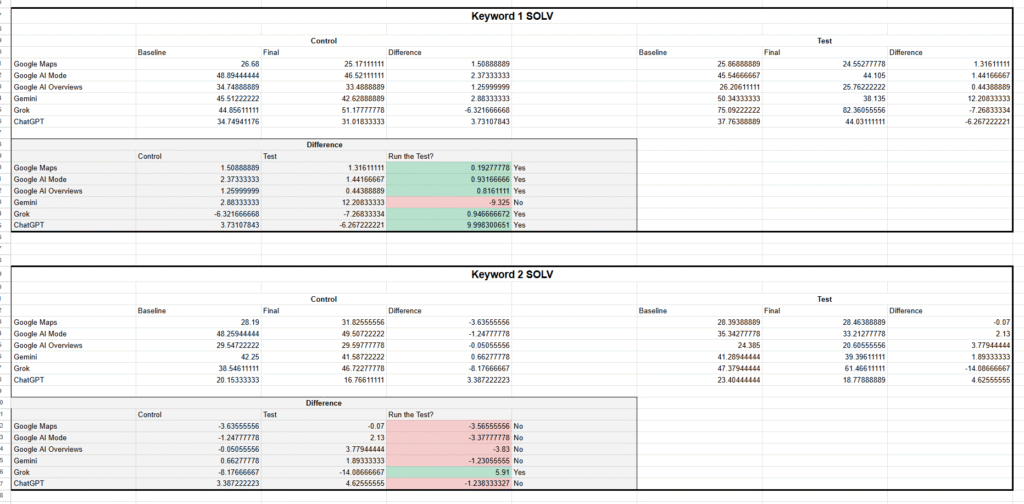
Similar to Average Total Rank (ATRP) for the same keywords in Google Maps, LocalBusiness schema produced absolutely no confidence in the improvement of SOLV.
Looking at the raw data, we have to flip our logic for running the confidence tests. Remember, SOLV is expressed as a percentage, so positive numbers in the “Run the Test?” column indicate the test should be run.
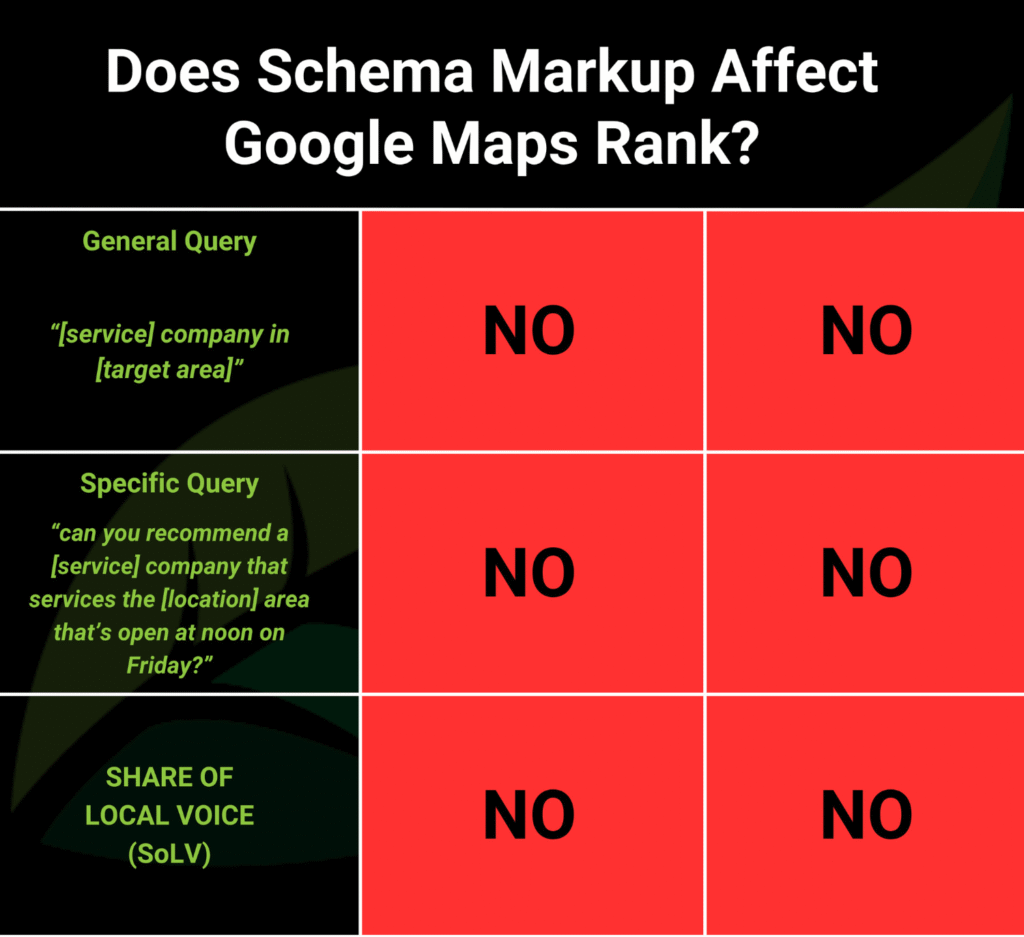
Final Verdict
LocalBusiness schema does not impact Google Maps ranking or Share of Local Voice.

AI and LLM Rank and Visibility with LocalFalcon
This is the section I know everyone is waiting for.
“How does schema affect LLM recommendations and AI visibility?”
Well, it depends on which LLM you’re using. It also depends on which tool you’re using.
Note on AI Tracking Tools
For tracking LLM and AI output, we wanted to use LocalFalcon’s geogrid. The main reason being that LocalFalcon has mastered “entity detection” in their reporting.
A common issue with AI reporting tools is being able to detect brands (entities). If you want to know your “position” in an LLM output, you have to tell the reporting tool what your brand is and all the variations of that brand name. I would have to tell them that we are “Evergrow Marketing”, our legal name is “Evergrow Marketing LLC”, some people call us “Evergrow” and sometimes people cite us with a capital “G”. Then I would have to do that for all possible competitors.
In most cases, it’s completely impractical.
LocalFalcon has mastered this. Entity and brand detection is baked in to the reporting. Not only for yours, but any and all entities. From there, it can generate rank and position reports for LLM output.
Here is standard geogrid in LocalFalcon. This report was run for the “lawn care company in [service area]” with ChatGPT.
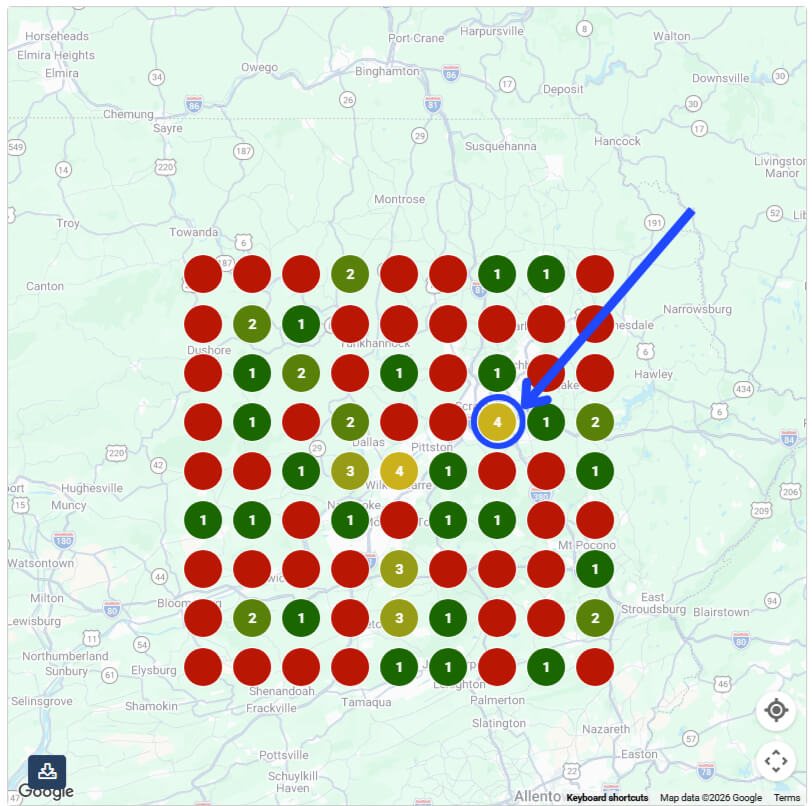
When I click on the circled grid point with position “4”, you get the actual output of the search that was taken at that coordinate along with the Brand Rankings.
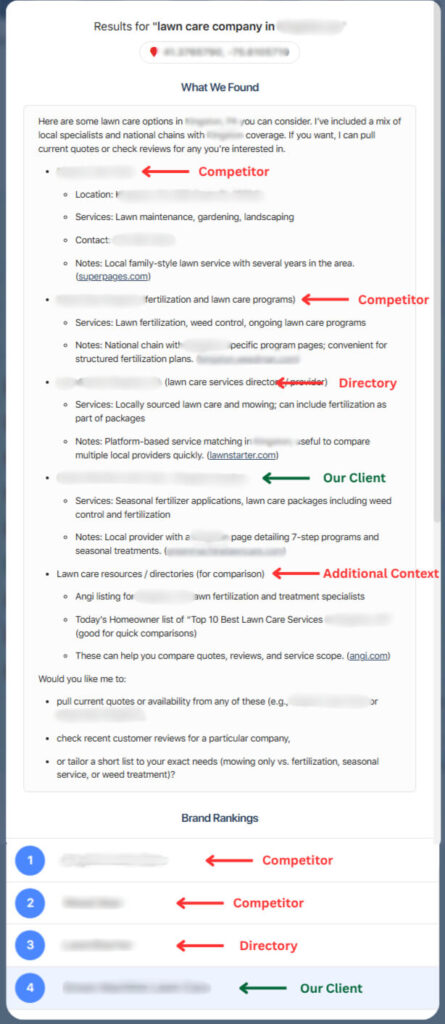
You’ll see in the screenshot, that our client is, in fact, in the 4th “position”.
So when looking at the results below on “rank”, just keep in mind that, yes, depending on tool you’re using, you can absolutely track “rank” in an LLM provided that tool has robust entity and brand tracking capabilities.
On a final note, it’s worth it to point out that LLM geogrids and Google Maps geogrids look vastly different. With Google Maps, you tend to see clusters of rankings that get worse the further out from the business location you go. With LLM geogrids, it’s all over the place. The results below are averages across the entire grid.
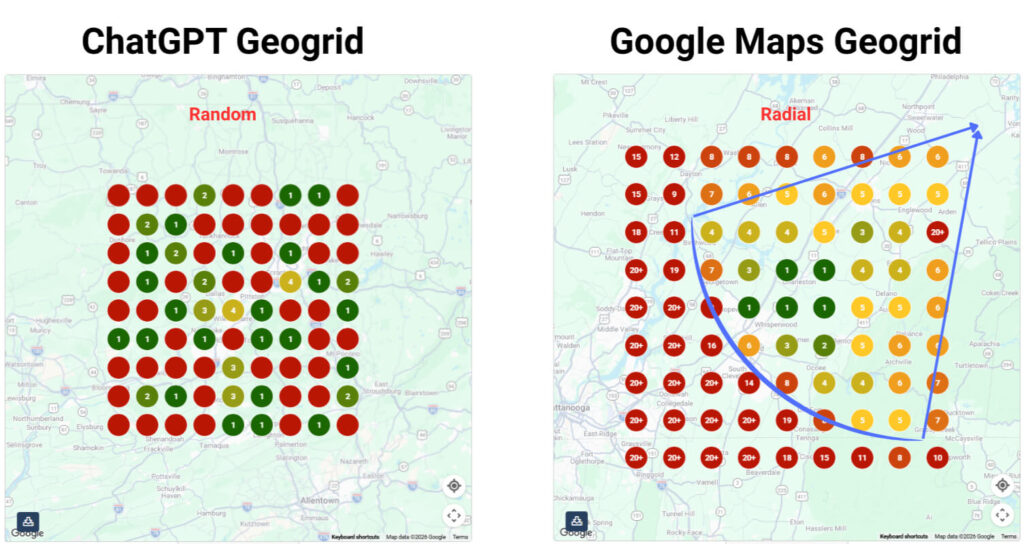
With that in mind, let’s review the LLM “rankings”.
For Query #1 (“[service] company in [location]”), these were the results.
Query #1 Control Group Change
Control Group Benchmark Query #1 AI “Rank”
- Google AI Mode: 13.66
- Google AI Overviews: 12.07
- Gemini: 12.5
- Grok: 15.85
- ChatGPT: 12.65
Control Group Final Query #1 AI “Rank”
- Google AI Mode: 12.21
- Google AI Overviews: 9.6
- Gemini: 10.6
- Grok: 15.46
- ChatGPT: 11.97
Query #1 Test Group Change
Test Group Benchmark Query #1 AI “Rank”
- Google AI Mode: 12.72
- Google AI Overviews: 13.37
- Gemini: 12.05
- Grok: 15.13
- ChatGPT: 12.63
Test Group Final Query #1 AI “Rank”
- Google AI Mode: 11.56
- Google AI Overviews: 10.65
- Gemini: 9.96
- Grok: 15.41
- ChatGPT: 8.63
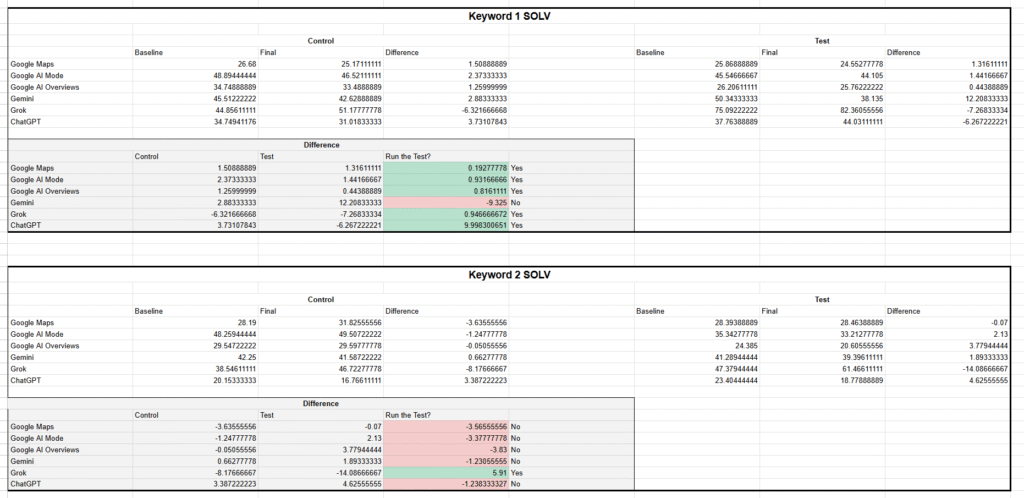
The Test Group outperformed the Control Group only with Google AI Overviews and Gemini, with confidence scores in the 50-60%% range that schema had an impact… in other words, a coin flip.
However, ChatGPT comes out victorious on this. Not only with the Test Group outperforming the Control Group, but the T-test showing 92.91% confidence that LocalBusiness schema had a positive effect on how high up ChatGPT recommends your brand.
Adding LocalBusiness Schema is highly likely to improve your brand’s positioning in ChatGPT by 3.33 positions.
For Query #2 (“can you recommend a lawn care company that services the [location] area that’s open at noon on Friday?”), the TL;DR is, “no, schema has no impact on this query for any AI / LLM platform in this test.” But I’ll post the results anyway.
Query #2 Control Group Change
Control Group Benchmark Query #2 AI “Rank”
- Google AI Mode: 11.3
- Google AI Overviews: 11
- Gemini: 10.7
- Grok: 14.18
- ChatGPT: 13.05
Control Group Final Query #2 AI “Rank”
- Google AI Mode: 9.55
- Google AI Overviews: 6.91
- Gemini: 10.14
- Grok: 12.38
- ChatGPT: 11.08
Query #2 Test Group Change
Test Group Benchmark Query #2 AI “Rank”
- Google AI Mode: 10.08
- Google AI Overviews: 9.16
- Gemini: 9.36
- Grok: 9.24
- ChatGPT: 7.56
Test Group Final Query AI #2″Rank”
- Google AI Mode: 10.09
- Google AI Overviews: 8.68
- Gemini: 7.37
- Grok: 9.21
- ChatGPT: 6.87
The only exception here is with Google AI Overviews. None of the LLMs outperformed the Control Group except AI Overviews, in which we could run the T-test. With 89.29% confidence, we found that schema could impact position. 90% is my cutoff… but 89.29% is pretty close.
What about Share of Local Voice?
For AI, LocalFalcon uses a similar metric called “Share of AI Voice (SAIV). But we’re just going to use the standard “SOLV” acronym for consistency here.
Here are the percentages and changes for Query #1 and #2 given the benchmark and final reporting of each group:
Query #1 SOLV Control Group Change
Control Group Benchmark Query #1 AI “SOLV”
- Google AI Mode: 48.89%
- Google AI Overviews: 34.75%
- Gemini: 45.51%
- Grok: 44.86%
- ChatGPT: 34.75%
Control Group Final Query #1 AI “SOLV”
- Google AI Mode: 46.52%
- Google AI Overviews: 33.49%
- Gemini: 42.63%
- Grok: 51.18%
- ChatGPT: 31.02%
Query #1 SOLV Test Group Change
Test Group Benchmark Query #1 AI “SOLV”
- Google AI Mode: 45.55%
- Google AI Overviews: 26.21%
- Gemini: 50.34%
- Grok: 75.09%
- ChatGPT: 37.76%
Test Group Final Query #1 AI “SOLV”
- Google AI Mode: 44.11%
- Google AI Overviews: 25.76%
- Gemini: 38.14%
- Grok: 82.36%
- ChatGPT: 44.03%
Again, another victory for ChatGPT here.
The only platform the Test Group didn’t outperform was Gemini, which means confidence tests were run on Google AI Mode, Google AI Overviews, Grok, and ChatGPT. All of which received confidence scores between 52.77% and 60.23%, except for ChatGPT, which yet again surpasses the 90% threshold at 91.51%.
LocalBusiness schema had a positive impact on how often ChatGPT references a brand, and the improvement was by 10 percentage points.
In other words, if ChatGPT recommends you 50% of the time in its list of recommendations, adding LocalBusiness schema would improve that rate to 60%.
Now let’s look at Query #2:
Query #2 SOLV Control Group Change
Control Group Benchmark Query #2 AI “SOLV”
- Google AI Mode: 48.26%
- Google AI Overviews: 29.55%
- Gemini: 42.25%
- Grok: 38.55%
- ChatGPT: 20.15%
Control Group Final Query #2 AI “SOLV”
- Google AI Mode: 49.51%
- Google AI Overviews: 29.6%
- Gemini: 41.59%
- Grok: 46.72%
- ChatGPT: 16.77%
Query #2 SOLV Test Group Change
Test Group Benchmark Query #2 AI “SOLV”
- Google AI Mode: 35.34%
- Google AI Overviews: 24.39%
- Gemini: 41.29%
- Grok: 47.38%
- ChatGPT: 23.4%
Test Group Final Query #2 AI “SOLV”
- Google AI Mode: 33.21%
- Google AI Overviews: 20.61%
- Gemini: 39.4%
- Grok: 61.47%
- ChatGPT: 18.78%
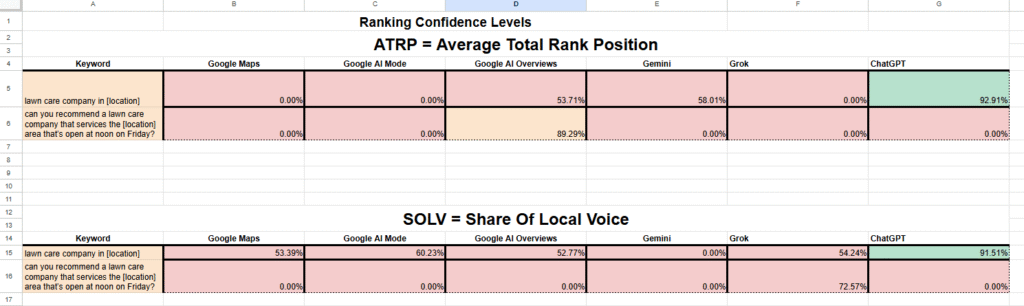
With query #2, nothing shocking here. The Test Group only outperformed the Control Group using Grok, and the confidence was 72.57%, which doesn’t even meet the generous 80% threshold needed to be considered.
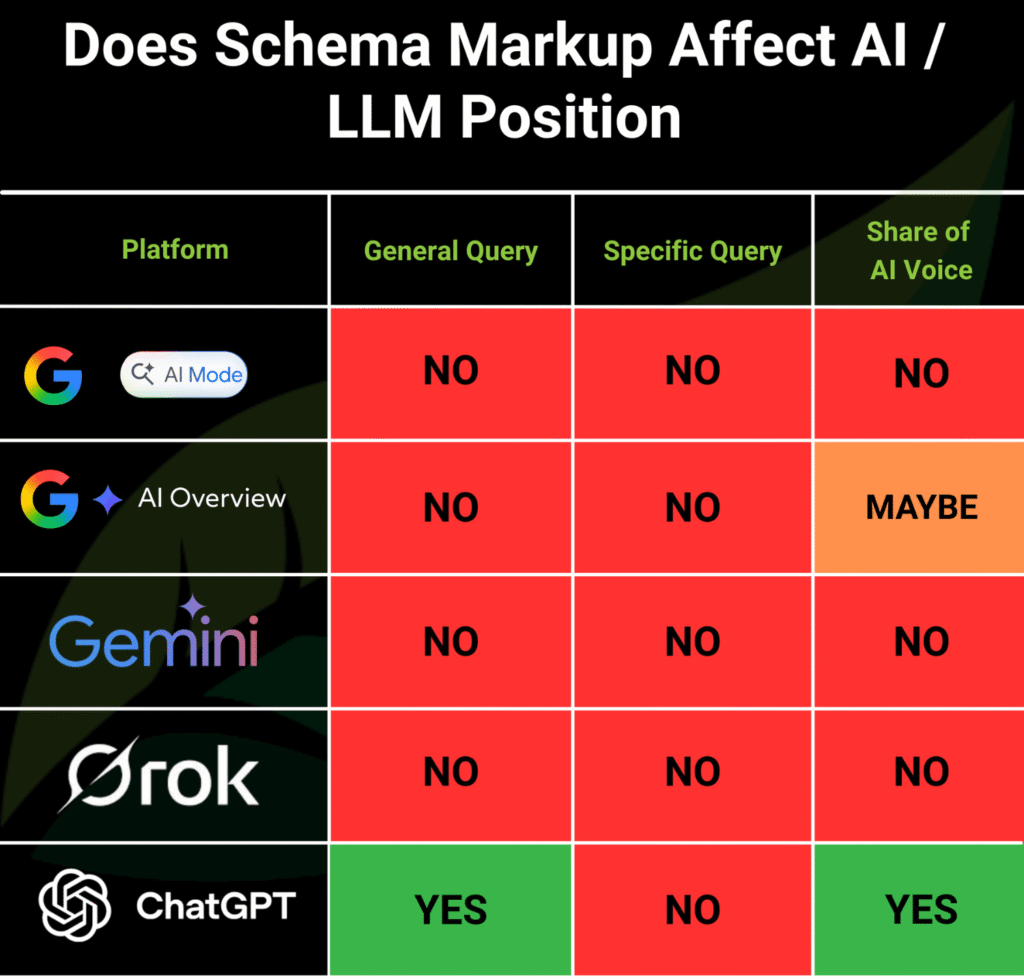
Still, that’s two categories that ChatGPT sees over a 90% confidence rating that schema did, in fact, influence both how high up ChatGPT recommended the brand and how frequently ChatGPT recommended them.
Final Verdict
Overall, no real movement from any LLM that’s Google-related or Grok, but a significant analysis from ChatGPT suggesting schema does impact visibility.
If you want to read into the results, with 92.91% confidence, adding LocalBusiness schema to your site will increase your ChatGPT position by 3.33 positions and your overall visibility by about 10 percentage points.

Conclusion
I’ve long stood the ground that no matter what acronym you use, whether it be GEO, AIO, AEO, etc, it’s all still SEO. Even after this, seeing how schema doesn’t affect rank for search engines but seems to have a positive effect for ChatGPT, I’ll still stand my ground on “it’s all just SEO”. It’s just a different way people search.
We even saw a possible lift in Yahoo!. Yahoo! is another way people search, just like using ChatGPT.
However, there are a few facts we should look at, and depending on how you have positioned your business model… you may need to rethink some things or delete some old posts…
- Schema does not affect Google Maps ranking
- Schema does not affect SERP ranking nor overall visibility
- Schema does affect ChatGPT
I’m curious as to why or how ChatGPT considers schema markup. Is there a protocol built in to look for that first because it’s easier to parse? Did OpenAI secretly build their own search index? Doubt it.
This test doesn’t ask “why”. It merely uncovers what is and what is not.
If you’re a local business owner trying to figure out whether or not you need schema, the answer is “Probably not. There are other things to worry about. This is not a magic bullet, and it’s not even a requirement on the first page.”
If you’re an agency or SEO and you’re wondering if you should implement it for your clients, my answer is, “Why not? It takes 10 minutes to add LocalBusiness schema.
It is worth noting that schema is critical to be shown for some things:
- Job listings in Google
- Hotel reservations in Google
- Travel/airline industry results
- Product schema for showing in organic search vs Google Shopping
- etc
There are things like that on which Google and other search engines rely on schema to display in standard organic search results.
Google is king and they’re taking AI search by storm, especially with their latest update in their overhaul of search. Since their standard search engine is moving closer to an AI-only powered platform, the results of this study indicate that no Google properties rely on schema to rank or source results. Google Search, Gemini, AI Overviews, and AI Mode all lacked confidence in the study.
This, bundled with Google’s continued deprecation of schema types, I see a future where schema is no longer relevant. On the flipside, with rising costs of AI-computing being a major environmental and monetary concern, I see the need for more “structure”.
It’s also worth it to consider that Google isn’t the only player in search and other search engines (or “answer engines”) may still favor it now and in the future.
Only time will tell.
This is the kind of study the SEO space needs more of. Bringing in reviewers on both sides before the test even ran, including Jarno van Driel, gives the findings real credibility instead of just confirmation bias dressed up in charts.
The Google Maps and SERP results don’t shock me, but they’re validating when you’re a local services company trying to make real decisions with a real budget. The ChatGPT finding is a different story though. A 93% confidence interval and a 10-point SOLV lift is hard to wave away, especially when we’re already seeing customers say “ChatGPT rec’d you.” That’s not theoretical anymore.
The question I keep sitting with after reading this: are we basically talking about schema as ChatGPT optimization at this point, rather than Google optimization? Because if so, that’s a pretty significant shift in how local businesses should be thinking about it. Would love to see a follow-up on whether more detailed schema types move the needle any further. Really great work here.
This is a really good point! It gives credit to those who differentiate SEO/AEO/AIO/GEO, etc. I’m still not a fan of calling it anything other than “SEO”. Pretty soon Google is headed into an AI-first/only search experience and it’ll still be SEO. But even you made the same insinuation regarding the differentiation between Google optimization and ChatGPT optimization in your comment.
Most people equate SEO to just Google when that isn’t the case. SEO is “Search Engine Optimization”. That includes ALL search engines. Google, Bing, Yahoo!, Angi’s, Yelp, etc. These are all search engines. Even Facebook is a search engine. I published an article on that in Search Engine Watch back in 2018. This study shows that LocalBusiness schema does nothing for Google but does seem to impact Yahoo! (potentially).
ChatGPT is just another search and discovery platform that appears to use different signals for different queries.
If you want to view schema as “ChatGPT optimization” instead of Google Optimization, you certainly can. But it can also be used to optimize for other search engines too.
If you’re in ecommerce, you definitely want product markup for listing products in organic Google. If you’re posting a job on your site you definitely want JobPosting schema to show your job listings in Google.
I don’t know if I would look at schema as inherently “ChatGPT optimziation”, rather an overall thing to consider when optimizing for search (no matter the platform), but be intentional about it. There’s no reason to focus so heavily on it when your
h1‘s aren’t even localized if you’re a local business.Fixating on schema like this could be a classic case of “stepping over dollars to pick up dimes”.
Thank you for sharing, Jake. I was looking forward to seeing what you found here. Interesting and I’m sure sharing this with folks in my SEO department will create some controversy where I’m at.
“Does Schema Markup Affect Rank and AI Recommendations?” is a pretty broad headline for a study that focuses on just two Schemas. Interesting findings none the less and totally agree – getting ones house in order (content wise) should always come before worrying about Schema support.
Product and Ratings Schemas have their obvious benefits within SERPs and rich results but I’m wondering if Breadcrumb schema now has additional value in the AI world. Is it beneficial to explicitly map the relationships between content and collections of content beyond URL structure?
My assumption is yes as it may help AI-enabled search systems understand topical relationships, content depth, and page context more accurately, which may improve eligibility to be interpreted, cited, or grouped correctly.
But you know what they say about assumptions.